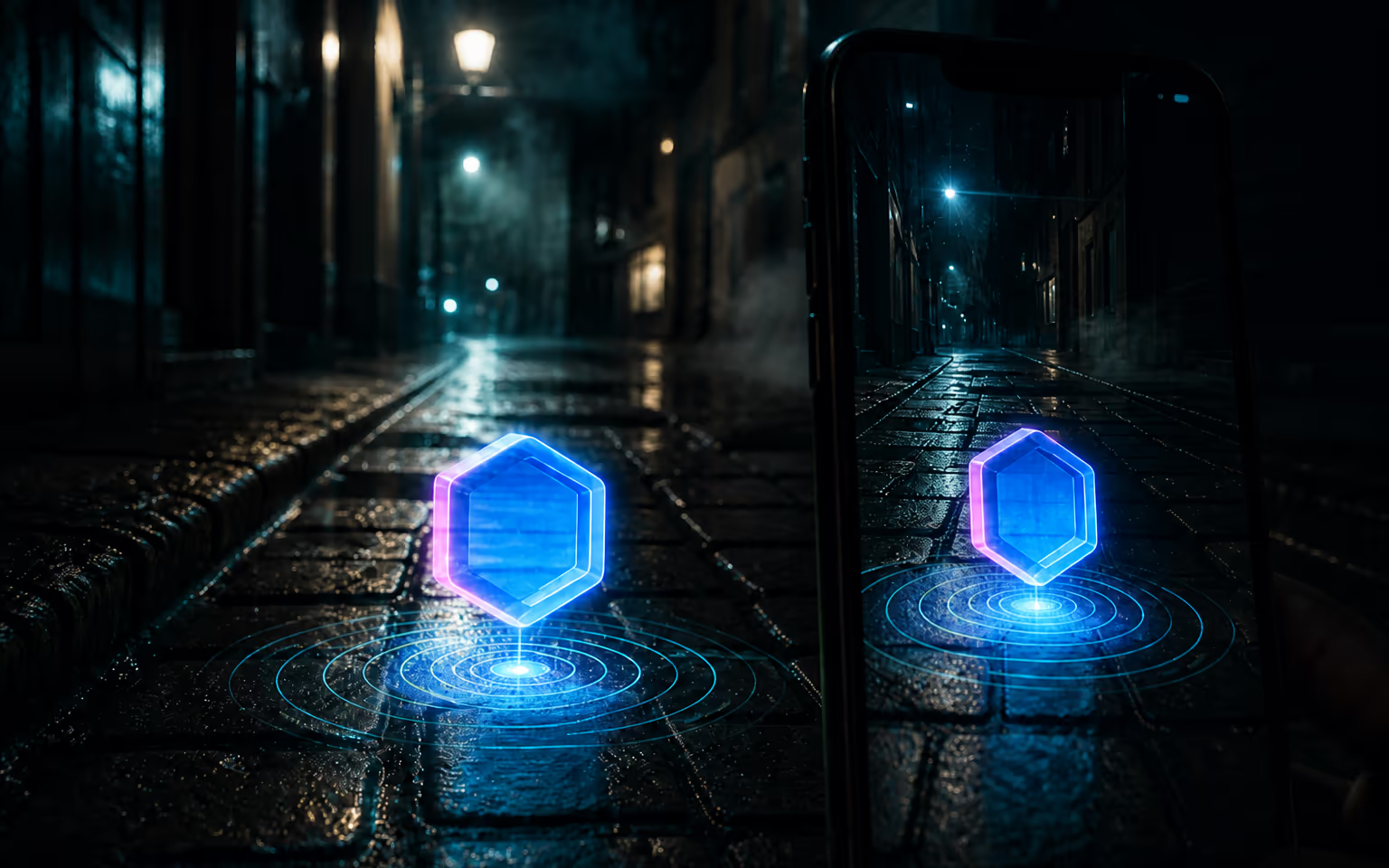
An AR treasure hunt is a game where the treasure is real and the map is your city. You open an app, walk to a coordinate, hold up your camera, and something appears there. A coin. A collectible. A coupon. A piece of story. If you were not standing where the game says the treasure is, the treasure does not appear. That constraint is the whole point.

The genre gets collapsed into geocaching, or into Pokémon Go, or into museum audio tours with a graphic overlay. It is none of those, and the differences matter more than they look.

Geocaching hides a physical container at a real location; the hunt is finding it, and the reward is a logbook entry. AR treasure hunts skip the container. The object lives in software and gets rendered onto the world through a camera pass. That means the same coordinate can host a different reward for every user, or a limited edition that empties as people arrive, or an escalating story that unfolds across a route. A wooden logbook cannot do any of that.

Pokémon Go is closer in shape but different in what it counts. Its creatures are generated procedurally, its lures are dropped by other players, and its economy is closed: every coin, potion, and Pokémon lives inside the game and cannot leave. An AR treasure hunt built on a chain lets what you find belong to you. A limited edition drop from a brand you like is an item in your wallet, not a badge on a profile you cannot export.

A museum audio tour with a graphic overlay is a guided path through content the museum wrote. AR treasure hunts are open in the sense a city is open: anyone can place, anyone can collect, and the interesting encounters happen because people who did not coordinate with each other happened to be on the same block on the same day.

Three technical pieces sit under a working AR treasure hunt. The first is the anchor. Every treasure is pinned to a specific coordinate, a latitude, a longitude, and often an altitude, with a claim radius that defines how close you have to be. A tight radius (five metres) is a doorway. A wide one (five hundred metres) is a festival ground. The anchor is what makes the treasure exist somewhere rather than everywhere.

The second is the render. Once you are inside the radius, the app puts the treasure in the camera view, in the right place, at the right scale, and, if the platform is any good, it stays put between sessions. Two people standing at the same doorway see the same coin in the same spot. You do not each get your own private hallucination. This is the piece that separates a proper AR platform from a filter.

The third is proof. The system needs to know you were physically there before it lets you claim, because otherwise the entire game is a spoofed GPS coordinate and the treasure is worthless to whoever placed it. Cheap proof relies on GPS alone and gets faked in ten minutes. Real proof combines the satellite fix with the ambient radio environment, device attestation, and a motion trace that shows you actually walked. All four have to agree.

The word for this last piece is proof of location, and it is the interesting one. Every other component, anchoring, rendering, camera, has been solved by AR SDKs for years. What was missing was a verification layer good enough that a publisher would put a real reward at a real coordinate and trust the person collecting it had actually shown up. Without that, AR treasure hunts stayed a novelty. With it, they become a distribution channel.

In 2026, retail is the loudest adopter. Streetwear labels drop limited-edition virtual accessories at flagship stores; the drop empties in twenty minutes and half the crowd is standing outside the shop. Coffee chains anchor a two-euro credit at each of their branches during a launch week. The value to the brand is not the AR, it is the verified visit. A campaign that costs a fixed amount per verified arrival at the door is directly comparable to a rent-and-billboard number, and often wins on it.

Cities and cultural venues use it differently. A museum can place an AR object at the entrance of a bricked-up alley that once led to its old back door and tell a story about the neighbourhood. A tourism board can lay a self-guided route through the food district with a small reward at each stop. The AR is part of the experience, not the point of it. The point is that the visitor spent an hour walking places they would not have otherwise found.

And there are the games that use the format for its own sake. Community treasure hunts run by local Discord servers. Multi-city scavenger raids that spawn on the same weekend everywhere. Chained puzzles where the answer to one drop is the coordinate of the next. These are smaller in aggregate reach than the retail drops, but they are the ones that keep people coming back.

Starting as a player takes a minute. Download an AR treasure hunt app, open the map, and start walking. If you have never held a private key in your life, that is fine: a wallet is created for you from a social login, and the collectibles land in it whether you know the phrase 'seed phrase' or not. The wallet becomes yours to export whenever you want it.

Starting as an organiser is different work. You pick a coordinate, you pick a reward, you pick a radius and a duration and how many copies exist, and you fund it. Most modern platforms have a self-serve tool for this; some (including us today, briefly) still set the first campaigns up alongside you. The interesting variable is not the tool. It is what you are willing to give away, and where.

What still does not work: indoor GPS is bad enough that placing a drop inside a shopping mall requires a beacon or a QR fallback. Wearables adoption is smaller than the marketing suggests, so treasure hunts remain phone-first for at least another generation of hardware. And weather matters more than you would think, nobody walks three streets to a virtual coffee credit in a storm, and the drop just sits there.

If the format sounds interesting and you want to try one, Seekprotocol is the app we build. It is the reason we know a lot of the above happens in practice rather than only on paper. And if you want to place a treasure of your own, at your shop, your event, your museum, the publisher side of the same protocol is what you would use.

The genre is still small, and we are early to it. That is the useful part. Anyone reading this who wants to be the first thing someone finds when they open the map on their block still can be. It is a treasure hunt with the treasures on both sides of the camera.